
Maven Trading Review 2026: Is This Prop Firm Legit?

Maven Trading
Reviewed by TraderFuelStrong value and program variety, but the rule set changes materially between account types.
View Maven Trading ProgramsMaven Trading is a legitimate simulated prop trading provider with unusually broad program choice and low entry pricing. Its strongest products are the standard 1-Step and 2-Step evaluations, while the 3-Step route offers smaller profit targets at the cost of a tighter loss allowance. The main weakness is not payout frequency or price; it is rule complexity. Traders must understand exactly how daily loss, trailing drawdown, profitable-day requirements and news restrictions apply to the specific account they buy.
How TraderFuel evaluated Maven Trading
This review is based on Maven Trading’s public pricing page, FAQ and trading-rule documentation, together with the supplied July 2026 Feefo snapshot and the new Trustpilot-removal image. We checked the program structure instead of relying on promotional claims.
- Compared profit targets, daily loss and maximum drawdown across the core programs.
- Reviewed payout frequency, profit split, withdrawal conditions and scaling limits.
- Separated verified official terms from user-review sentiment.
- Checked whether the old Trustpilot claim was still appropriate.
Correction from the previous version: Maven Trading no longer has a visible Trustpilot rating in the supplied July 2026 evidence. TraderFuel therefore removes the old Trustpilot score and treats Feefo as a separate review source, not as a replacement Trustpilot rating.
The 2026 Expert Verdict
✅ The Good
- Core profit split of 80%.
- Low-cost entry options and frequent coupon pricing.
- Multiple funding routes instead of one rigid challenge.
- 10-business-day payout cycle on core programs.
- Scaling pathway up to $1 million.
⚠️ The Trade-Offs
- Rules vary substantially by program.
- 1-Step and Instant use trailing maximum drawdown.
- 2-Step requires profitable days during evaluation and before withdrawal.
- Standard programs restrict profitable trade closures around high-impact news.
- Maven Minis are short-duration promotional products, not normal funded accounts.
What Is Maven Trading?
Maven Trading is an education-focused simulated prop firm launched in 2022. It sells evaluation programs in which traders operate virtual accounts under predefined risk limits. Traders who pass and complete verification can access a simulated funded stage and receive a share of eligible simulated profits. Maven states that traders may hold up to $200,000 in combined starting funded capital and scale qualifying accounts to $1 million.

The firm is notable for product breadth. Its main forex lineup includes 1-Step, 2-Step and 3-Step evaluations, Instant Funding, Maven Minis and a Buy Now, Pay Later evaluation. That breadth creates choice, but it also makes the rules harder to compare. A trader who reads only the headline price can easily purchase the wrong model.
Maven Trading Account Types and Current Rules
The table below focuses on the core rules that materially affect risk. Prices change by account size, platform, location and promotion, so TraderFuel does not present one temporary checkout price as permanent.
1-Step Challenge
- Profit target: 8%
- Daily loss: 3%, based on higher balance/equity at 00:00 UTC
- Maximum loss: 5% trailing from highest equity
- Profit split: 80%
- Payout cycle: 10 business days
- Consistency score: None on the standard pricing table
2-Step Challenge
- Profit targets: 8% then 5%
- Daily loss: 4%, based on higher balance/equity at 00:00 UTC
- Maximum loss: 8% static
- Profitable days: 3 days at 0.5% in each phase and funded stage before withdrawal
- Profit split: 80%
- Payout cycle: 10 business days
3-Step Challenge
- Profit targets: 3% / 3% / 3%
- Daily loss: 2%, based on higher balance/equity at 00:00 UTC
- Maximum loss: 3% static
- Profit split: 80%
- Payout cycle: 10 business days
- Best for: Low-volatility, low-risk execution
Instant Funding
- Profit needed to withdraw: 3%
- Daily loss: 2%
- Maximum loss: 3% trailing
- Maximum open risk: 1% difference between balance and equity
- Consistency: Largest trade must remain below 15% of total profit
- Profit split: 80%
Maven Minis
- Trading window: 24 hours from first trade
- Open positions: One trade at a time
- Daily loss: 2%
- Maximum loss: 3% trailing
- Consistency: 15% based on largest trade
- Profit split: 20% on the promotional Mini described in the FAQ
Buy Now, Pay Later
- Entry: $5 upfront, remaining fee after passing
- Evaluation target: 4%
- Evaluation daily loss: None
- Evaluation maximum loss: 10% static
- Funded daily loss: 4% EOD
- Funded maximum loss: 8% trailing with 20% consistency
Maven Trading Rules You Must Understand
1. Trailing drawdown follows equity on 1-Step and Instant
A trailing maximum drawdown rises with the highest equity recorded, including floating profit. Giving back an unrealized gain can therefore breach the account even when the balance remains above the original starting loss threshold. This is the most important risk in Maven’s 1-Step and Instant products.
2. Daily loss is recalculated at 00:00 UTC
For the standard programs, the daily-loss reference is the higher of balance or equity at the daily rollover. Holding a profitable position through 00:00 UTC can raise the next day’s reference point and reduce available room if the trade reverses.
3. High-impact news restrictions apply to standard programs
On the standard challenge and funded routes, traders cannot open or close profitable trades during the two minutes before or after an affected red-folder release. A take-profit or automatic closure inside the window can also trigger the restriction. Maven’s FAQ states that this standard news rule does not apply to Instant accounts.
4. The 2-Step requires profitable days
Each evaluation phase requires three days with at least 0.5% profit. The funded stage also requires three qualifying profitable days before a withdrawal. Reaching the total profit target alone is not enough.
5. Prohibited trading behavior is broadly defined
Maven prohibits high-frequency trading, tick scalping, arbitrage, reverse hedging, account mirroring, copying other traders, reckless layering and attempts to pass by risking most of the drawdown on a single low-quality trade idea. Traders should read the current terms before purchasing because enforcement depends on trading behavior, not only numerical limits.
6. The core payout split is 80%
The standard Instant, 1-Step, 2-Step and 3-Step programs use an 80% simulated profit split. Maven lists direct bank transfer, Rise and other payout methods, with availability depending on the trader’s country.
Maven Trading Reviews: Trustpilot Rating Removed, Feefo Still Visible
The previous TraderFuel article displayed a Trustpilot score that is no longer appropriate. The newly supplied image shows that Maven Trading’s Trustpilot rating has been removed, so this review does not assign or repeat an outdated Trustpilot score.

Maven also maintains a separate Feefo profile. The supplied July 2026 Feefo snapshot shows a 4.8/5 service score, 2,158 ratings over the previous year and 3,862 reviews displayed in total at the time of capture.
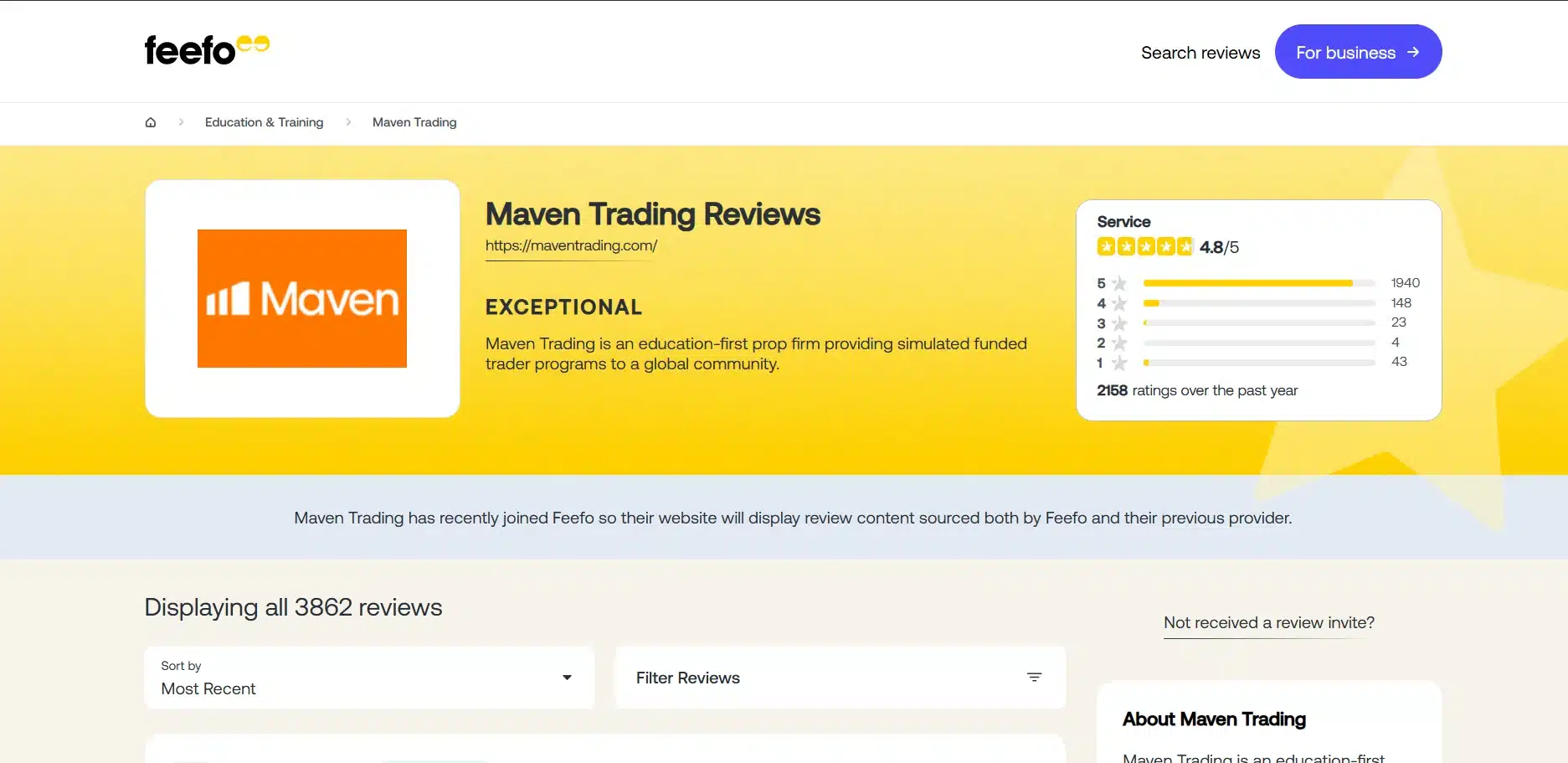
That score is strong, but it needs context. Feefo explicitly states that Maven recently joined the platform and that review content may include feedback sourced from Feefo and Maven’s previous provider. Therefore, the total review count should not be interpreted as thousands of reviews collected exclusively by Feefo under one unchanged methodology.
What traders commonly praise
- Low evaluation fees and recurring promotional pricing.
- Quick customer-support responses.
- Multiple challenge formats for different risk preferences.
- Reports of successful and relatively fast payouts.
- Simple dashboard and account-purchase process.
What requires caution
- Trailing drawdown can be misunderstood by aggressive traders.
- Minimum profitable days delay passing or withdrawal on the 2-Step.
- Some reviews mention payout delays or additional account checks.
- Different products contain different consistency and withdrawal rules.
- The imported-review notice limits direct comparability with other platforms.
Maven Trading vs. Instant Funding
Maven Trading and Instant Funding both offer evaluations and direct-funding routes, but they are not interchangeable. TraderFuel has direct payout experience with Instant Funding, while this Maven assessment is based on documented rules, platform research and public feedback.
Maven Trading
Instant Funding
Program variety, low-cost entry points and access to static-drawdown evaluation choices.
Firsthand TraderFuel payout evidence and selected products with faster withdrawal availability.
Who Should Choose Maven Trading?
Maven is best suited to traders who want to choose between several risk models instead of accepting one universal evaluation. The 2-Step is the most sensible all-round option because its 8% static maximum loss provides more breathing room than the 1-Step’s 5% trailing limit. The 3-Step can work for conservative strategies that can operate within a 3% total loss allowance.
Maven is a poor fit for traders who routinely hold large floating profits through the daily rollover, depend on closing trades during major economic announcements, or dislike profitable-day requirements. Instant Funding also demands disciplined risk because the 3% trailing limit and 15% largest-trade consistency rule leave little room for highly concentrated wins.
Maven Trading Frequently Asked Questions
Is Maven Trading legit?
What is the best Maven Trading challenge?
Does Maven Trading use trailing drawdown?
How often does Maven Trading pay?
Does Maven Trading allow news trading?
What Maven Trading discount codes are active?
Final Verdict: Is Maven Trading Worth It?
Strong value, but choose the program carefully.
Maven Trading earns a positive rating because its pricing, public track record and program variety are better than average. The firm is not equally attractive across every product. TraderFuel recommends the 2-Step for most disciplined traders and would avoid the 1-Step or Instant route unless the trader already understands equity-based trailing drawdown.
✅ Consider Maven if:
- You want a low-cost evaluation.
- You prefer an 80% profit split.
- You want a static-drawdown 2-Step or 3-Step option.
- You can comply with news and profitable-day rules.
⚠️ Look elsewhere if:
- You dislike trailing equity drawdown.
- You depend on high-impact news trading.
- You want one simple rule set across every account.
- You expect an evaluation fee to guarantee funding.



Great breakdown of funding options and risk control in today’s trading environment. I especially liked how you explained speed, transparency, and trader flexibility in simple terms. I recently came across WeMasterTrade while researching similar models, and it seems to align well with what you described here for both new and experienced participants globally. Have you noticed how instant access is changing trader confidence and decision-making across different markets?
Glad you enjoyed the breakdown! You’re spot on about instant access; it’s shifting the psychology of trading by providing immediate skin in the game.
Interestingly, I have a full We Master Trade Review on my site where I dive deeper into their specific approach. Thanks for sharing your thoughts!”