
Rithmic Vs. Tradovate: The Ultimate Engineering & Latency Deep Dive
Whether you trade from Los Angeles, London, Mumbai, or Buenos Aires, the physical distance to the Chicago CME servers is your silent enemy. When evaluating Rithmic vs Tradovate, your choice of data feed dictates your execution speed, order flow fidelity, and operational survival in prop firms.
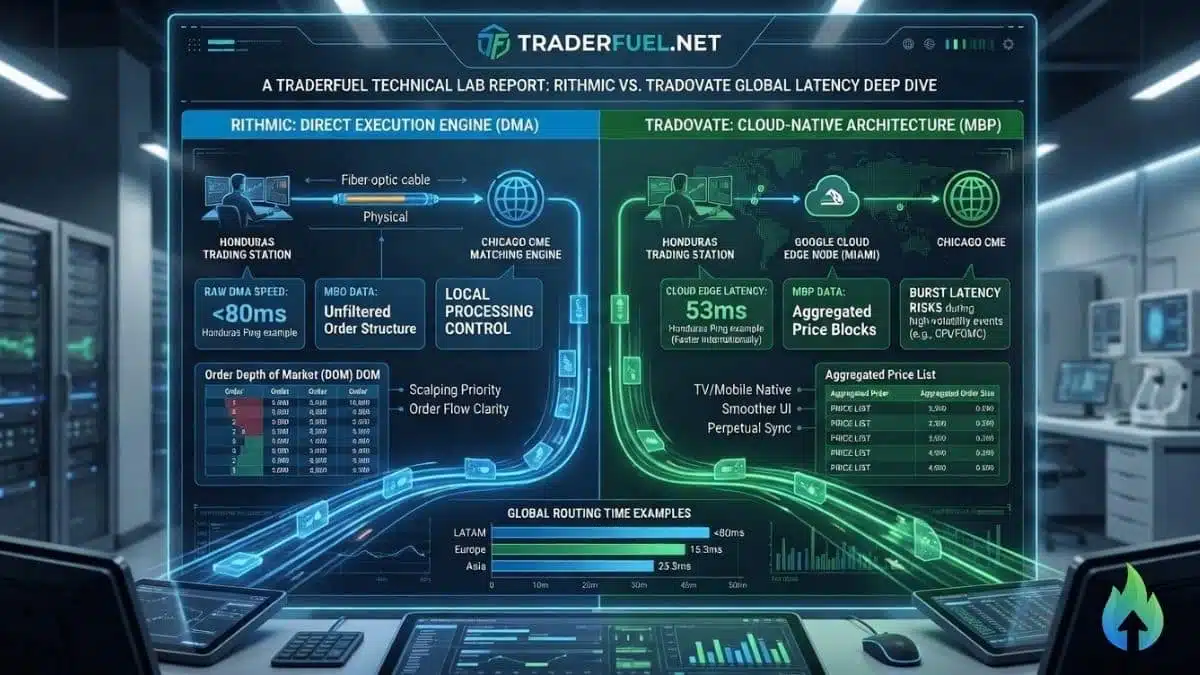
⚙️ Rithmic vs Tradovate: Evolution & Architecture
To truly understand the core differences in the Rithmic vs Tradovate debate, it is imperative to analyze the journey a data packet takes from the matching engine of the CME Group in Chicago to your trading terminal.
Rithmic (Broker-Neutral DMA)
Rithmic is not a broker itself, but a high-speed technology layer facilitating Direct Market Access (DMA).
Its design focuses on optimizing network protocols to deliver unfiltered data with microsecond ($10^{-6}$ s) timestamps.
This architecture requires most data processing to happen locally or on dedicated servers, granting traders granular control over execution.
Tradovate (Cloud-Native Paradigm)
Tradovate represents a massive paradigm shift toward Cloud Computing. It integrates the platform, data feed, and brokerage services into one verticalized solution.
Tradovate’s infrastructure receives exchange data on its servers and redistributes it via efficient web protocols (WebSockets), allowing perpetual synchronization across desktops, tablets, and smartphones.
⚡ The Impact of Latency on Prop Firm Survival
In the prop firm ecosystem, where traders operate third-party capital under strict risk management rules, latency is a survival factor. A delay of a few milliseconds on an exit order can result in hitting a trailing drawdown and losing a funded account. Total latency is calculated as a complex function of multiple variables:
Rithmic: Raw Execution
Rithmic excels in reducing network and platform latency through direct connections (DMA).
For scalpers trading highly volatile contracts like the Nasdaq (NQ), Rithmic’s raw speed allows orders to enter the exchange queue with higher priority.Tradovate: Cloud Susceptibility
Conversely, while Tradovate offers excellent standard latency for discretionary trading, its cloud infrastructure can suffer from “burst latency” during high-impact macroeconomic events (like CPI or FOMC). During these spikes, the cloud must process massive message volumes for thousands of concurrent users, occasionally resulting in momentary charting delays or order confirmation lag.
🌍 Rithmic vs Tradovate Latency: A Global Routing Case Study
Most traders mistakenly believe their internet speed is the sole bottleneck. In reality, geographical distance and ISP routing dictate execution speed. To prove this, we conducted an exhaustive Traceroute and ICMP Ping study from Honduras (Central America) to the data centers in Chicago. Note: This principle applies equally to traders in Europe, Asia, or the US West Coast.
🔬 Tradovate API
live.tradovateapi.com⚙️ Rithmic CME
ritmz01001.01.rithmic.comThe Professional Latency Hack: If your ping naturally exceeds 80ms, the physical limit of light through fiber optics is working against you. Professional traders bypass this by renting a VPS in Chicago (near the CME Aurora Datacenter), dropping Rithmic latency to an elite 1-3 ms globally.
🔍 The Engine: MBO vs. MBP Data Fidelity
This is the technical divide that separates retail pattern traders from institutional Order Flow scalpers. The feed you choose determines what you can see on the DOM.
Rithmic (MBO)
Market By Order: The exchange transmits data for every individual order in the queue, unfiltered.
- X-Ray Vision: Essential for Footprint charts (Jigsaw, Sierra Chart).
- Detect Manipulation: Spot Iceberg Orders (hidden sizes) and Queue Flipping (spoofing).
- Micro-Tick Precision: Identifies exactly which orders are absorbed at a specific price level.
Tradovate (MBP)
Market By Price: Aggregates all pending orders at a specific price level into a single block.
- Smoother UI: Perfect for standard Volume Profiles and 90% of retail strategies.
- Data Throttling: May aggregate data during massive volatility (CPI/FOMC) to prevent browser freezing.
- The Trade-off: You lose the micro-structure fidelity needed for aggressive DOM scalping.
📋 Trade Copiers & Multi-Account Architecture
Passing 20 prop firm accounts simultaneously is the 2026 standard for scaling capital. The feed dictates your copier software and operational risk.
Rithmic + Replikanto
Coping occurs locally on your PC via NinjaTrader 8. Incredibly stable for 20 accounts within the same prop firm ID. However, mixing IDs from multiple firms restricts connections and spikes local CPU load.
Tradovate API
Tools like PickMyTrade use cloud APIs to sync trades. If your local PC crashes, Tradovate’s server-side OCO brackets protect followers. Risk: Cloud processing latency during fast markets can cause “replication slippage”.
💰 Rithmic vs Tradovate: The Economics of Data Feeds
Your tech choice impacts your wallet. Because traders statistically blow accounts during evaluations, the cost of resetting is a critical business metric.
- Activation fee is generally cheaper.
- Lowest reset cost industry-wide.
- Ideal for aggressive scalpers needing multiple retries.
- Activation carries a small premium.
- Premium for cloud access.
- Perfect for TradingView native execution.
- Powered by Tradovate tech.
- Resets included in monthly subscription.
- Built-in risk management tools.
- No activation on new plans.
- Low entry barrier.
- $148 Lifetime Activation Fee.
- Economic option for large accounts.
The Final Verdict
If you need X-ray vision (Order Flow) and trade on Windows: Pick Rithmic.
If you need freedom (Mac/Mobile/TradingView) and trade patterns: Pick Tradovate.
Technical FAQ
Tradovate is significantly easier for beginners as it requires no complex software installation—you simply log in via your browser. Rithmic is built for professionals, requiring network configuration and Windows-based platforms.
Yes. Following NinjaTrader’s acquisition of Tradovate, you can log into NinjaTrader Desktop using Tradovate credentials, blending cloud accessibility with desktop charting power.
Tradovate is the undisputed winner for the Apple ecosystem. It runs natively in browsers and has dedicated Mac apps. To run Rithmic on a Mac, you must use hardware-heavy virtual machines like Parallels.
If you placed an OCO (One-Cancels-Other) bracket containing your Stop Loss and Take Profit, you are protected. Both Rithmic and Tradovate hold bracket orders server-side. If you entered a bare market order, you are fully exposed until reconnection.